

2025-09-15
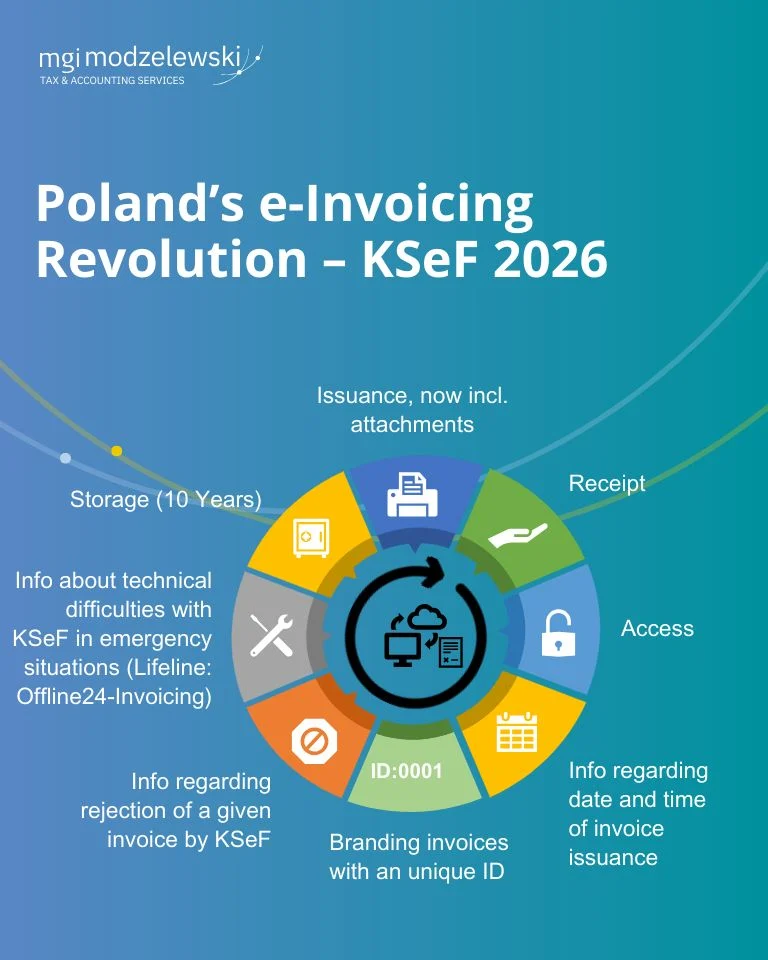
Poland’s e-Invoicing Revolution – KSeF 2026
KSeF 2.0 is here – the President of Poland has signed the bill! On August 27, 2025, the President approved amendments to the VAT Act introducing the new version of the National e-Invoicing System (KSeF). This marks one of the most significant tax reforms in recent years – transforming how every Polish company or entrepreneur issues and processes invoices.
KSeF 2.0 is here – the President of Poland has signed the bill!
On August 27, 2025, the President approved amendments to the VAT Act introducing the new version of the National e-Invoicing System (KSeF).
This marks one of the most significant tax reforms in recent years – transforming how every Polish company or entrepreneur issues and processes invoices.
KSeF rollout schedule
• February 1, 2026 – mandatory for entities with 2025 sales above PLN 200M (incl. VAT)
• April 1, 2026 – mandatory for other businesses
• January 1, 2027 – exception for micro-enterprises (monthly invoiced sales ≤ PLN 10K)
What’s new in KSeF 2.0
• “offline24” mode – a business may issue invoices outside the system, as long as they are uploaded to KSeF till the end of the next business day.
• Invoice attachments – the option to attach documents directly to invoices (hint: requires prior request).
• KSeF certificates – available from November 1, 2025, essential for authentication and offline mode.
• VAT corrections – the timing of submission to KSeF will at most times determine when VAT adjustments are to be made.
Who is exempt?
Foreign businesses registered for Polish VAT without a “fixed establishment” in Poland are not required to use KSeF.
Still, they may opt in voluntarily – for example, if requested by key Polish clients.
What does this mean for Polish business?
• Invoicing will become fully digital and centrally recorded, similar to Italy (as from 2020)
• KSeF 2.0 is more than just another compliance requirement – it’s a fundamental shift in how invoicing works across Poland.
See other articles
Poland’s draft bill UD116 could significantly change the tax treatment of certain entrepreneurs operating under B2B arrangements. The proposed rules would not abolish self-employment or Poland’s lump-sum tax regime on recorded revenue. However, they are intended to reduce the tax attractiveness of certain structures, particularly transactions with related parties, service businesses operating without employees, and the use of the Polish IP Box regime.

The Act of 29 May 2026 amending the Polish Tax Ordinance and certain other acts, signed by the President of Poland, introduces significant changes to the Polish rules on reporting tax schemes, commonly referred to as MDR, or Mandatory Disclosure Rules. The new MDR provisions are expected to enter into force on 1 October 2026 and will substantially narrow the scope of obligations which, since 2019, have been one of the more demanding elements of tax compliance in Poland.

Tax proceedings in Poland should not be a process in which only the tax authority decides which facts will be examined and which evidence will be taken into account. Under the Polish Tax Ordinance Act, taxpayers have the right to actively participate in proceedings, including the right to submit their own requests for evidence. In practice, however, not every piece of evidence proposed by a taxpayer will be admitted. When can the tax authority refuse an evidentiary request, and what options are available to taxpayers in such situations?

Determining when a VAT liability arises in relation to services remains one of the more challenging issues in practice under Polish VAT law. Although Article 19a(1) of the Polish VAT Act clearly states that VAT becomes due when a service is performed, establishing when a service is actually “performed” sometimes requires a case-by-case assessment of the contractual model and the underlying commercial reality. Recent Polish judgment by the Supreme Administrative Court of 31 March 2026 (I FSK 1353/23) provides important clarification in the context of IT services.

As the Polish National e-Invoicing System (KSeF) becomes more widely used, businesses are increasingly encountering a practical issue known as the “double document circulation.” This occurs when the structured invoice stored in KSeF (XML) differs from the PDF visualization sent to the customer, for example by email or through a customer portal.

On 11 February, the EU General Court (Case T-689/24) delivered an important judgment in a “Polish case” on the moment of input VAT deduction. The ruling may have far-reaching consequences for Polish businesses and the way VAT is settled in Poland.

Invoice Issued Outside KSeF and Tax-Deductible Costs. Key Position of the Polish tax administration.
Individual tax ruling of 9 January 2026, ref. 0111-KDIB1-3.4010.714.2025.2.JG In an individual tax ruling dated 9 January 2026, the Director of the Polish National Revenue Information (KIS) addressed an issue that has raised significant practical concerns in the context of the implementation of the National e-Invoicing System (KSeF). The key question was whether an expense documented by an invoice issued outside the KSeF-system may be treated as a tax-deductible cost for the purposes of Polish corporate income tax (CIT).

The introduction of the mandatory Polish e-invoicing system (Krajowy System e-Faktur – KSeF) as of 1 February 2026 will significantly change VAT invoicing rules, i.a. transactions involving foreign entities. One of the key factors determining whether mandatory KSeF applies is whether a foreign counterparty has a fixed establishment (FE) in Poland. If it is lacking on the seller’s side, then he may issue and send invoices outside KSeF (e.g. via e-mail, PDF). If the seller is subject to KSeF yet his buyer is not (lacking seat/FE in Poland), then the seller must issue the invoice via KSeF, yet simultaneously send it to his buyer in the old-fashioned way.

The general tax ruling issued by the Polish Minister of Finance and Economy on 27th of November 2025 addresses the issue of land, buildings and structures being deemed as “related to business activity”. It is one of the most significant documents in recent years in the area of property taxation. Its importance goes well beyond a purely technical explanation of statutory provisions. At its core, it touches on a fundamental and long-running dispute between taxpayers and tax authorities: where the line should be drawn between mere ownership of real estate and its use for business purposes.
Even though penalties for issuing invoices outside Poland’s National e-Invoicing System (KSeF) have been deferred until 1 January 2027, the real headache may come sooner.