

2026-06-18

Evidence requests in Polish tax proceedings – when can the tax authority refuse to admit evidence?
Tax proceedings in Poland should not be a process in which only the tax authority decides which facts will be examined and which evidence will be taken into account. Under the Polish Tax Ordinance Act, taxpayers have the right to actively participate in proceedings, including the right to submit their own requests for evidence. In practice, however, not every piece of evidence proposed by a taxpayer will be admitted. When can the tax authority refuse an evidentiary request, and what options are available to taxpayers in such situations?
Taxpayers have the right to contribute to the evidentiary record
One of the fundamental principles of Polish tax proceedings is the obligation to establish the facts of the case thoroughly and accurately. The tax authority must take all necessary steps to determine the actual circumstances relevant to the outcome of the case.
This does not mean, however, that only the authority is responsible for building the evidentiary record. The principle of active participation allows taxpayers to submit their own evidence and request that specific evidentiary measures be carried out.
Evidence in tax proceedings may include documents, accounting records, witness testimony, expert opinions and any other means capable of helping to establish the facts. The catalogue of admissible evidence is open-ended, giving taxpayers broad opportunities to demonstrate circumstances relevant to their case.
When must the tax authority admit evidence?
The key provision is Article 188 of the Polish Tax Ordinance Act. Under this rule, a taxpayer’s request to admit evidence should be granted if it
concerns facts that are relevant to the case, unless those facts have already been sufficiently established by other evidence.
In other words, the tax authority may not arbitrarily disregard evidence submitted by a taxpayer. If the evidence could help clarify material facts, it should generally be admitted.
This principle was confirmed by the Supreme Administrative Court of Poland in its judgment of 11 December 2025 (case no. I FSK 1820/24). The Court held that a tax authority may not refuse evidence favourable to a taxpayer merely because it considers the existing evidentiary record sufficient. Such an approach could result in selective evidence gathering and undermine the principles of objectivity and impartiality.
This position is particularly important in practice. In tax disputes, authorities sometimes focus primarily on evidence supporting their own conclusions while downplaying evidence presented by taxpayers. Polish administrative courts have consistently emphasised that such an approach is incompatible with procedural rules.
The tax authority is not required to admit every piece of evidence
At the same time, a taxpayer’s right to submit evidentiary requests is not unlimited. Tax authorities are not obliged to admit every piece of evidence proposed by a party.
As the Supreme Administrative Court of Poland stated in its judgment of 11 April 2024 (case no. II FSK 1904/23), a refusal to admit evidence is justified not only where the relevant fact has already been sufficiently established by other evidence, but also where the fact in question is irrelevant to the outcome of the case or where the proposed evidence is incapable of proving that fact.
Similarly, in its judgment of 25 October 2023 (case no. I FSK 576/23), the Court stressed that Article 188 does not require authorities to grant every evidentiary request made by a taxpayer. A request may be refused where the relevant fact has already been established or where it is immaterial to the resolution of the case.
The Provincial Administrative Court in Poznań, Poland, reached a similar conclusion in its judgment of 21 March 2024 (case no. I SA/Po 874/23), holding that a taxpayer’s right to propose evidence does not automatically oblige the authority to carry out every requested evidentiary measure.
It should also be remembered that tax authorities are required to conduct proceedings efficiently and without undue delay. Consequently, requests that merely duplicate evidence already collected or cannot contribute to clarifying the facts of the case may be rejected. Admitting such evidence could unnecessarily prolong the proceedings.
From a taxpayer’s perspective, this means that evidentiary requests should be carefully prepared. Simply identifying a piece of evidence may not be sufficient. Taxpayers should explain which specific facts the evidence is intended to prove and why those facts are relevant to the outcome of the case.
What can a taxpayer do if evidence is refused?
A refusal to admit evidence is issued in the form of a procedural order. Importantly, under Polish tax procedure rules, such an order cannot be challenged by way of a separate interlocutory appeal.
This does not mean, however, that the authority’s decision is beyond review. The taxpayer may challenge the refusal in an appeal against the final tax decision.
If the matter subsequently reaches the administrative courts, the court will review the legality of the evidentiary proceedings and assess whether the authority had valid grounds for refusing the requested evidence.
It is worth noting that courts generally do not conduct evidentiary proceedings to the same extent as tax authorities. For this reason, submitting appropriate evidentiary requests during the audit or tax proceedings stage is often crucial to the effectiveness of a taxpayer’s defence.
Conclusion
The right to submit evidentiary requests is one of the key procedural safeguards available to taxpayers in disputes with Polish tax authorities. Although authorities are not required to admit every piece of evidence proposed by a taxpayer, any refusal must be based on specific legal grounds and properly justified. The practical takeaway is straightforward: taxpayers should actively participate in proceedings, submit evidence supporting their position, and ensure that their evidentiary requests are properly substantiated. In many cases, the outcome of a dispute with the tax authorities will depend largely on the evidentiary stage of the proceedings.
See other articles

Reform of Poland’s tax ruling system: five-year validity and centralisation of municipal tax rulings
Businesses engaged in distance selling often issue an invoice as soon as goods leave the warehouse. Where delivery is handled by a third-party carrier, however, the actual date on which the supply takes place may not yet be known. This raises the question of whether the seller may issue an invoice without specifying the date of supply and whether, once delivery has been confirmed, the missing date must be added by means of a corrective invoice. These issues were addressed by the Director of Poland’s National Revenue Information Service (KIS) in an individual tax ruling dated 14 July 2026, reference no. 0114-KDIP1-2.4012.236.2026.2.RM. The ruling may be particularly relevant to businesses operating in the e-commerce, manufacturing and logistics sectors, especially where deliveries take place around the end of a VAT reporting period.
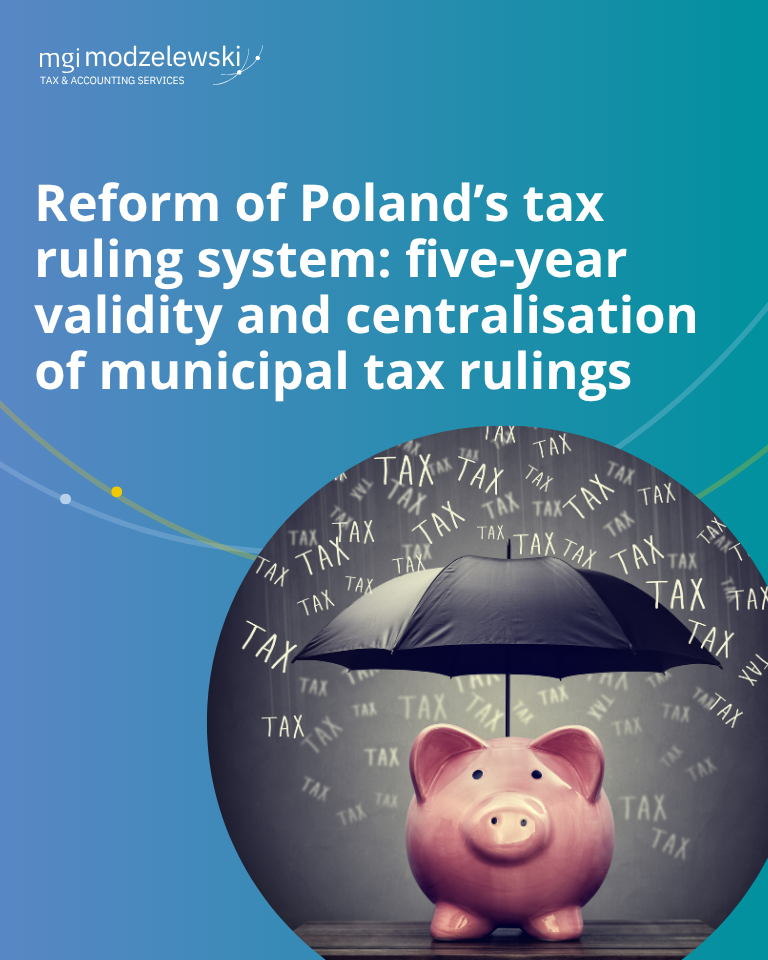
Reform of Poland’s tax ruling system: five-year validity and centralisation of municipal tax rulings
Poland’s Ministry of Finance is preparing a comprehensive reform of the rules governing the issuance and operation of tax rulings. Draft Bill UD445 provides, among other things, for a five-year validity period for individual tax rulings, a procedure for extending their protective effect, broader protection covering tax consequences arising before a ruling is served, and new grounds on which existing rulings may cease to apply. Draft Bill UD450, in turn, would transfer responsibility for issuing rulings on taxes and charges administered by municipal tax authorities to the Director of the National Tax Information Service. Not all elements of the reform are at the same stage of the legislative process. Draft Bills UD445 and UD450 have not yet been enacted. However, legislation requiring municipal tax rulings to be published in the central EUREKA tax rulings database has already been adopted. When assessing the implications of the reform, it is therefore important to distinguish between enacted measures and legislative proposals whose final wording may still change.
Poland’s draft bill UD116 could significantly change the tax treatment of certain entrepreneurs operating under B2B arrangements. The proposed rules would not abolish self-employment or Poland’s lump-sum tax regime on recorded revenue. However, they are intended to reduce the tax attractiveness of certain structures, particularly transactions with related parties, service businesses operating without employees, and the use of the Polish IP Box regime.

The Act of 29 May 2026 amending the Polish Tax Ordinance and certain other acts, signed by the President of Poland, introduces significant changes to the Polish rules on reporting tax schemes, commonly referred to as MDR, or Mandatory Disclosure Rules. The new MDR provisions are expected to enter into force on 1 October 2026 and will substantially narrow the scope of obligations which, since 2019, have been one of the more demanding elements of tax compliance in Poland.
Tax proceedings in Poland should not be a process in which only the tax authority decides which facts will be examined and which evidence will be taken into account. Under the Polish Tax Ordinance Act, taxpayers have the right to actively participate in proceedings, including the right to submit their own requests for evidence. In practice, however, not every piece of evidence proposed by a taxpayer will be admitted. When can the tax authority refuse an evidentiary request, and what options are available to taxpayers in such situations?

Determining when a VAT liability arises in relation to services remains one of the more challenging issues in practice under Polish VAT law. Although Article 19a(1) of the Polish VAT Act clearly states that VAT becomes due when a service is performed, establishing when a service is actually “performed” sometimes requires a case-by-case assessment of the contractual model and the underlying commercial reality. Recent Polish judgment by the Supreme Administrative Court of 31 March 2026 (I FSK 1353/23) provides important clarification in the context of IT services.

As the Polish National e-Invoicing System (KSeF) becomes more widely used, businesses are increasingly encountering a practical issue known as the “double document circulation.” This occurs when the structured invoice stored in KSeF (XML) differs from the PDF visualization sent to the customer, for example by email or through a customer portal.

On 11 February, the EU General Court (Case T-689/24) delivered an important judgment in a “Polish case” on the moment of input VAT deduction. The ruling may have far-reaching consequences for Polish businesses and the way VAT is settled in Poland.

Invoice Issued Outside KSeF and Tax-Deductible Costs. Key Position of the Polish tax administration.
Individual tax ruling of 9 January 2026, ref. 0111-KDIB1-3.4010.714.2025.2.JG In an individual tax ruling dated 9 January 2026, the Director of the Polish National Revenue Information (KIS) addressed an issue that has raised significant practical concerns in the context of the implementation of the National e-Invoicing System (KSeF). The key question was whether an expense documented by an invoice issued outside the KSeF-system may be treated as a tax-deductible cost for the purposes of Polish corporate income tax (CIT).

The introduction of the mandatory Polish e-invoicing system (Krajowy System e-Faktur – KSeF) as of 1 February 2026 will significantly change VAT invoicing rules, i.a. transactions involving foreign entities. One of the key factors determining whether mandatory KSeF applies is whether a foreign counterparty has a fixed establishment (FE) in Poland. If it is lacking on the seller’s side, then he may issue and send invoices outside KSeF (e.g. via e-mail, PDF). If the seller is subject to KSeF yet his buyer is not (lacking seat/FE in Poland), then the seller must issue the invoice via KSeF, yet simultaneously send it to his buyer in the old-fashioned way.